


Description
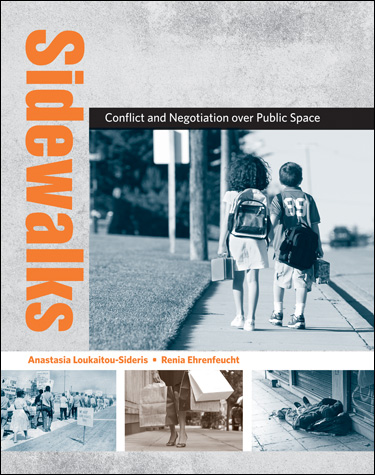
Urban sidewalks, critical but undervalued public spaces, have been sites for political demonstrations and urban greening, promenades for the wealthy and the well-dressed, and shelterless shelters for the homeless. On sidewalks, decade after decade, urbanites have socialized, paraded, and played, sold their wares, and observed city life. These many uses often overlap and conflict, and urban residents and planners try to include some and exclude others. In this first book-length analysis of the sidewalk as a distinct public space, Anastasia Loukaitou-Sideris and Renia Ehrenfeucht examine the evolution of the American urban sidewalk and trace conflicts that have arisen over its competing uses. They discuss the characteristics of sidewalks as small urban public spaces, and such related issues as the ambiguous boundaries of their “public” status, contestation over specific uses, control and regulations, and the implications for First Amendment speech and assembly rights.
Drawing on historical and contemporary examples as well as case study research and archival data from five cities—Boston, Los Angeles, New York, Miami, and Seattle—the authors focus on how the functions and meanings of street activities have shifted and have been negotiated through controls and interventions. They consider sidewalk uses that include the display of individual and group identities (in ethnic and pride parades, for example), the everyday politics of sidewalk access, and larger political actions (including Seattle’s 1999 antiglobalization protests) and examine the complex regulatory frameworks that manage street and sidewalk life. The role of urban sidewalks in the early twenty-first century depends, the authors conclude, on what we want from sidewalk life and how we balance competing interests.
CONTENTS
I History and Evolution
- 1 Introduction: The Social, Economic, and Political Life of Sidewalks
- 2 Construction and Evolution of Sidewalks
II Display, Opportunity, and Celebration
- 3 Promenading and the Performance of Individual Identities
- 4 Performing Collective Identities Parades, Festivals, and Celebrations
III Disruption and Confrontation
- 5 Everyday Politics and the Right to the Sidewalk
- 6 Sidewalk as Space of Dissent
IV Competing Uses and Meanings
- 7 Sidewalk as Space of Economic Survival
- 8 Sidewalk as Shelter
- 9 Sidewalk as Urban Forest
V Regulation and Control
- 10 Controlling Danger, Creating Fear
- 11 Municipalities in Control
- 12 Revisiting Public Space and the Role of Sidewalks
334 pages / 18 x 23 cm


Reviews
There are no reviews yet.