


Description
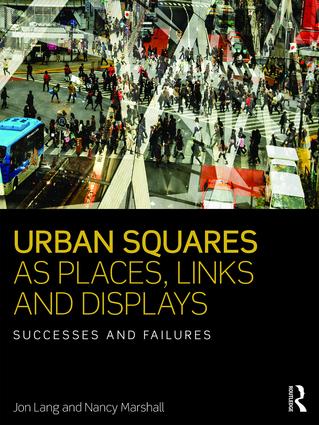
Urban Squares as Places, Links and Displays, Successes and Failures
To attract investment and tourists and to enhance the quality of life of their citizens, municipal authorities are paying considerable attention to the quality of the public domain of their cities – including their urban squares. Politicians find them good places for rallies. Children consider squares to be playgrounds, the elderly as places to catch-up with each other, and for many others squares are simply a place to pause for a moment.
Urban Squares as Places, Links and Displays: Successes and Failures discusses how people experience squares and the nature of the people who use them. It presents a ‘typology of squares’ based on the dimensions of ownership, the square’s instrumental functions, and a series of their basic physical attributes including size, degree of enclosure, configuration and organization of the space within them and finally based on their aesthetic attributes – their meanings. Twenty case studies illustrate what works and what does not work in different cities around the world. It discusses the qualities of lively squares and quieter, more restorative places as well as what contributes to making urban squares less desirable as destinations for the general public. The book closes with the policy implications, stressing the importance and difficulties of designing good public places.
Urban Squares offers how-to guidance along with a strong theoretical framework making it ideal for architects, city planners and landscape architects working on the design and upgrade of squares.
CONTENTS
Part 1: Introduction
- 1. Experiencing Public Open Spaces
- 2. Squares as Places, Links and Displays
- 3. Sociocultural Considerations
Part 2: Types of Urban Squares and their Design
- 4. Public, Quasi-public and Semi-public Squares
- 5. Types based on Instrumental Functions:
- 6. Types based on Size
- 7. Types based on Degree of Enclosure
- 8. Types based on Configurations
- 9. Types based on Internal Designs
- 10. Types based on Symbolic Functions
- 11. Types based on Design Paradigms
Part 3: Learning from Case Studies
- 12. A Score of Case Studies
- Rittenhouse House Square, Philadelphia
- Sproul Plaza, University of California at Berkeley
- Paley Park, New York
- Cours Honoréd-Estiennne d’Orves, Marseille
- La Place des Terreaux, Lyon
- Federation Square, Melbourne
- Paternoster Square, London
- Robson Square, Vancouver
- Olympic Plaza, Calgary
- Trafalgar Square, London
- The Capitol Square, Chandigarh
- Oxford Square, Sydney
- Pershing Square, Los Angeles
- Schouwburgplein, Rotterdam
- The Guggenheim Museum forecourt, Bilbao
- North and South Shanghai Railway Station Squares, Shanghai
- Jacob K. Javits Federal Building Plaza, New York
- Granary Square, London
- Times Square, New York
- Piazza San Marco, Venice
Part 4: What Works and What Doesn’t Work
- 13. The Qualities of Lively Urban Squares
- 14. The Qualities of Quiet Urban Squares
296 pages, 3 black & white tables, 162 colour illustrations, 3 colour line drawings / 19 x 24,5 cm / English


Reviews
There are no reviews yet.