


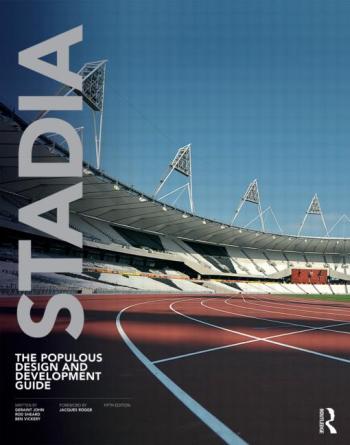
Description
In this fully updated and redesigned edition of the essential and long-established Stadia, the authors offer their unrivalled expertise to all professionals who commission, plan, design, and manage high-quality sports venues.
Ideas about the design and use of stadiums continue to evolve and this fifth edition includes the latest developments in the field. Including updated chapters on sustainability, masterplanning and services, a new chapter on branding activation, and new global case studies, the fifth edition of Stadia is the ultimate guide to all aspects of stadium design, from local club buildings to international showpieces.
In addition to a wide array of international case studies, the authors draw on the experience of the design firm Populous who in recent years delivered the 2010 Yankees Stadium in New York; the 2010 Aviva stadium, Dublin; the 2004 Benfica stadium, Lisbon; the 2010 Soccer City FNB Stadium, Johannesburg; the 2012 Marlins Park, Miami; and the 2012 new Olympic Stadium, London.
CONTENTS
1. The stadium as a building type
- 1.1 A venue for watching sport
- 1.2 History
- 1.3 Current requirements
- 2.1 The importance of the stadium as a building type
- 2.2 Economics of stadia
- 2.3 Stadium technology
- 2.4 Ergonomics and the environment
- 2.5 What is the future for the stadium?
- 3.1 The need for a masterplan at all sports grounds
- 3.2 Orientation of play
- 3.3 Zoning of the venue
- 3.4 Event overlay – what needs to be added to hold the event
- 3.5 Security against terrorism
- 3.6 Stadia in the city
- 4.1 Location
- 4.2 Transportation
- 4.3 Provision of parking
- 4.4 Stadium landscaping
- 5.1 The stadium as architecture
- 5.2 Structure and form
- 5.3 Materials
- 5.4 The playing surface
- 5.5 Foundations
- 5.6 Seating tiers
- 5.7 Concourses, stairs and ramps
- 5.8 Roof
- 6.1 Introduction
- 6.2 The threats from terrorism
- 6.3 Authorities
- 6.4 Implications for management and operation
- 6.5 Responses by the design team
- 6.6 Conclusion
- 7.1 Playing surfaces
- 7.2 Pitch dimensions, layout and boundaries
- 8.1 Introduction
- 8.2 National sports traditions
- 8.3 Financial viability
- 8.4 Catering for different sports
- 8.5 Catering for non-sports performances
- 9.1 General
- 9.2 Perimeter fences
- 9.3 Moats
- 9.4 Changes of level
- 10.1 Equal treatment
- 10.2 Sources of information
- 10.3 Design process
- 11.1 Introduction
- 11.2 Ground capacity
- 11.3 Viewing distances
- 11.4 Viewing angles and sightlines
- 11.5 Obstructions to viewing
- 12.1 Basic decisions
- 12.2 Seat types
- 12.3 Seat materials, finishes and colours
- 12.4 Choice
- 12.5 Dimensions
- 12.6 Seat fixings
- 12.7 Seating for spectators with disabilities
- 13.1 Introduction
- 13.2 Trends
- 13.3 Design
- 13.4 Multi-use
- 14.1 Basic principles
- 14.2 Stadium layout
- 14.3 Access between Zone 5 and Zone 4
- 14.4 Access between Zone 4 and Zone 3
- 14.5 Overall design for inward movement
- 14.6 Overall design for outward movement
- 14.7 Elements
- 14.8 Facilities for people with disabilities
- 15.1 Introduction
- 15.2 Automatic vending machines
- 15.3 Concessions
- 15.4 Bars
- 15.5 Self-service cafeterias, food courts and restaurants
- 15.6 Luxury restaurants
- 16.1 Toilet provision generally
- 16.2 Toilets for spectators
- 16.3 Scales of provision for spectator toilets
- 16.4 Location of spectator toilets
- 16.5 Detailed design
- 17.1 Introduction
- 17.2 Advance ticket sales
- 17.3 Programme sales
- 17.4 Gift and souvenir shops
- 17.5 Museums, visitor centres and stadium tours
- 18.1 Basic planning
- 18.2 Outside facilities
- 18.3 Press facilities
- 18.4 Radio broadcast facilities
- 18.5 Television broadcast facilities
- 18.6 Reception, conference and interview rooms
- 18.7 Provision for disabled people
- 19.1 Basic planning
- 19.2 Facilities for permanent management
- 19.3 Facilities for temporary events management
- 19.4 Facilities for visitors
- 19.5 Provision for stewards
- 19.6 Facilities for police and security officials
- 19.7 Toilets
- 19.8 First aid facilities for staff and spectators
- 19.9 Provision for disabled people
- 20.1 Basic planning
- 20.2 Players’ facilities
- 20.3 Team management facilities
- 20.4 Officials’ facilities
- 20.5 Medical examination facilities
- 20.06 Ancillary facilities
- 20.7 Provision for disabled people
- 21.1 Lighting systems
- 21.2 Closed-circuit television systems
- 21.3 Sound systems
- 21.4 Heating and cooling systems
- 21.5 Fire detection and fighting systems
- 21.6 Power supply and event continuation
- 21.7 Water supply and drainage services
- 21.8 Information technology 2
- 22.1 Introduction
- 22.2 Pitch maintenance
- 22.3 Stand maintenance
- 23.1 Stadium finances
- 23.2 Capital costs
- 23.3 Operating costs
- 23.4 Income generation
- 23.5 Controlling costs and revenues
- 23.6 Conclusion
- 24.1 What is sustainable design
- 24.2 Re-use
- 24.3 Reduce
- 24.4 Recycle
- 24.5 Planting and green roofs
- 24.6 Certification
- 24.7 Future technologies
- 25.1 Maximising revenue
- 25.2 Time, not space
- 25.3 Brand activation through integration: The fan experience
- 25.4 Marrying team brand with commercial identities
- 25.5 The process
- 01. Allianz Arena Munich, Germany
- 02. Amsterdam Arena Amsterdam, Netherlands
- 03. Anz Stadium Sydney, Australia
- 04. Arizona Cardinals Stadium Phoenix, USA
- 05. Ascot Racecourse Ascot, UK
- 06. Astana Stadium Astana, Kazakhstan
- 07. At&T Park San Francisco, USA
- 08. Aviva Stadium Dublin, Ireland
- 09. Braga Municipal Stadium Braga, Portugal
- 10. Cowboys Stadium Dallas, USA
- 11. Donbass Arena Donetsk, Ukraine
- 12. Emirates Stadium London, UK
- 13. Forsyth-Barr Stadium Dunedin, New Zealand
- 14. Greenpoint Stadium Cape Town, South Africa
- 15. Heinz Field Pittsburgh, USA
- 16. Marlins Park Miami, USA
- 17. Melbourne Cricket Ground Melbourne, Australia
- 18. Telstra Dome Melbourne, Australia
- 19. Nanjing Sports Park Nanjing, China
- 20. Oita Stadium Oita, Japan
- 21. Olympic Stadium London, UK
- 22. The Oval London, UK
- 23. Reliant Stadium Houston, USA
- 24. Salzburg Stadium Salzburg, Austria
- 25. Soccer City Johannesburg, South Africa
- 26. Soldier Field Chicago, USA
- 27. Stade De France Paris, France
- 28. Statteg Sports And Leisure Facility, Graz, Austria
- 29. Wembley Stadium London, UK
- 30. Westpac Stadium Wellington, New Zealand
- 31. Wimbledon Aeltc: Centre Court London, UK
340 pages / 22 x 27,5 cm


Reviews
There are no reviews yet.