
Description
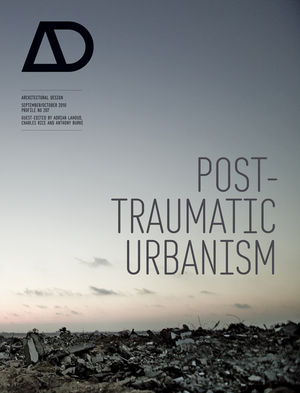
Urban trauma describes a condition where conflict or catastrophe has disrupted and damaged not only the physical environment and infrastructure of a city, but also the social and cultural networks. Cities experiencing trauma dominate the daily news. Images of blasted buildings, or events such as Hurricane Katrina exemplify the sense of ‘immediate impact’. But how is this trauma to be understood in its aftermath, and in urban terms? What is the response of the discipline to the post-traumatic condition? On the one hand, one can try to restore and recover everything that has passed, or otherwise see the post-traumatic city as a resilient space poised on the cusp of new potentialities. While repair and reconstruction are automatic reflexes, the knowledge and practices of the disciplines need to be imbued with a deeper understanding of the effect of trauma on cities and their contingent realities. This issue will pursue this latter approach, using examples of post-traumatic urban conditions to rethink the agency of architecture and urbanism in the contemporary world. Post-traumatic urbanism demands of architects the mobilisation of skills, criticality and creativity in contexts in which they are not familiar. The post-traumatic is no longer the exception; it is the global condition.
CONTENTS
- Editorial (Helen Castle).
- About the Guest-Editors (Adrian Lahoud, Charles Rice and Anthony Burke).
- Spotlight: Visual highlights of the issue.
- Introduction: Post-Traumatic Urbanism (Adrian Lahoud).
- Trauma Within the Walls: Notes Towards a Philosophy of the City (Andrew Benjamin).
- The Space-Time of Pre-emption: An Interview with Brian Massumi (Charles Rice).
- Making Dubai: A Process in Crisis (Todd Reisz).
- Changes of State: Slow-Motion Trauma in the Gangetic Plains of India (Anthony R Acciavatti).
- After the Event: Speculative Projects in the Aftermath (Samantha Spurr).
- Forensic Architecture (Eyal Weizman, Paulo Tavares, Susan Schuppli and Situ Studio).
- The Infrastructure of Stability (Tarsha Finney).
- Post-Apocalypse Now (Mark Fisher).
- The Eighth Day: God Created the World in Seven Days. This is The Eighth Day (Tony Chakar).
- Figures in the Sand (Christopher Hight and Michael Robinson).
- The Urban Complex: Scalar Probabilities and Urban Computation (Anthony Burke).
- Project for a Mediterranean Union (Adrian Lahoud).
- Fearscapes: Caracas Postcards from a Violent City (Eduardo Kairuz).
- Energy Territories (Anthony Burke).
- Architecture, Contingency and Crisis: An Interview with Slavojiek (Adrian Lahoud).
- The Very Mark of Repression: The Demolition Theatre of the Palast der Republik and the New Schloss Berlin (Khadija Carroll La).
- On Message: An Interview with Michael Chertoff (Charles Rice).
- Borderline Syndrome (Ole Bouman).
- Counterpoint: Rebuilding from Below the Bottom: Haiti (Jayne Merkel and Craig Whitaker).
136 pages, color ills / 22 x 29 cm / English


Reviews
There are no reviews yet.